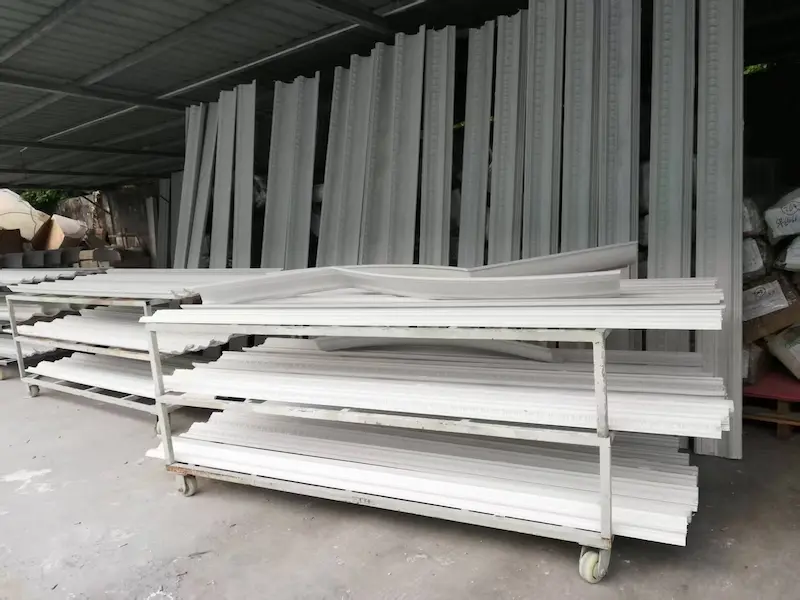
When choosing plaster for high-end casting, architectural decor, or specialized stone crafts, understanding the difference between Alpha (\alpha) Gypsum Powder and Beta (\beta) Gypsum Powder is crucial. Although both originate from calcium sulfate hemihydrate (\text{CaSO}_4 \cdot 0.5\text{H}_2\text{O}), their production methods, physical properties, and performance characteristics vary significantly.
- Production & Calcination Method
Alpha Gypsum: Produced using a high-temperature autoclaving process under wet pressure. This hydrothermal calcination allows crystals to grow slowly into dense, well-formed prisms.
Beta Gypsum: Manufactured using an open rotary kiln or boiling furnace at atmospheric pressure. This dry-calcination method causes rapid water evaporation, creating irregular, highly porous flakes. - Purity & Crystal Structure
Alpha Gypsum: Features high purity and a compact crystal lattice with minimal micro-pores.
Beta Gypsum: Contains more impurities and a loose, spongy crystal structure with higher void ratios. - Water-to-Powder Ratio
Alpha Gypsum: Requires significantly less water during mixing. Lower water demand leads to faster drying and higher structural integrity.
Beta Gypsum: Needs a much higher water ratio to achieve proper fluidity due to its porous crystal particles absorbing extra liquid. - Density & Bulk Volume
Alpha Gypsum: For the same weight (e.g., 1 metric ton), Alpha gypsum powder occupies less physical volume due to its high bulk density .
Beta Gypsum: Features a lower bulk density , meaning 1 metric ton will occupy a much larger volume. - Hardness & Compressive Strength
Alpha Gypsum: Offers superior mechanical strength, surface hardness, and abrasion resistance once cured. It resists chipping and breaking, making it ideal for high-precision molds and premium crafts.
Beta Gypsum: Possesses lower final hardness and compressive strength, making it easier to carve but less durable under load. - Primary Applications & Use Cases
Alpha Gypsum: Best suited for high-end stone crafts, candle jar casting, aroma stones, dental molds, and premium architectural moldings where fine detail and high strength are critical.
Beta Gypsum: Commonly used for standard building plasterboards, wall drywalling, joint compounds, and basic industrial casting where high strength is not required.
Conclusion
If your business focuses on high-precision casting, luxury candle containers, or durable architectural elements, Alpha Gypsum Powder provides the structural density, smooth finish, and strength necessary for premium products. For general construction or low-cost applications, Beta Gypsum remains a budget-friendly alternative.
Durable Building Plaster Powder for Construction & Wall Finish | TEKO